

South Africa said farewell on Saturday to Archbishop Desmond Tutu, the last great hero of the struggle against apartheid, in a funeral stripped of pomp but freighted with glowing tributes and showered with rain.
Tutu died last Sunday at the age of 90, triggering grief among South Africans and tributes from world leaders for a life spent fighting injustice.
Family, friends, clergy and politicians gathered at Cape Town’s St. George’s Cathedral where, for years, Tutu used the pulpit to rail against a brutal white minority regime. That is where he will be buried.
“Because we shared him with the world, you share part of the love you held for him with us, so we are thankful.”
“While our beloved (Nelson Mandela) was the father of our democracy, Archbishop Tutu was the spiritual father of our new nation.”
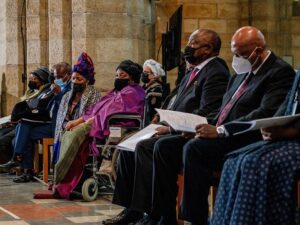
“His was a life lived honestly and completely. He has left the world a better place. We remember him with a smile,” said Ramaphosa before handing South Africa’s multicoloured flag to the “chief mourner”, Tutu’s widow, Leah.
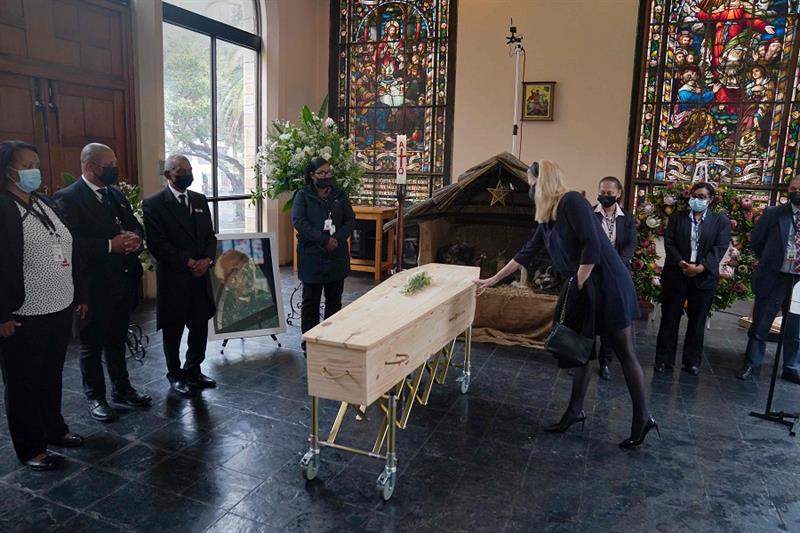
The funeral ended South Africa’s week of mourning, during which people filed past a diminutive rope-handled casket made of pine, adorned by a plain bunch of carnations.
Under a grey sky and drizzle, among the mourners ushered into the cathedral were ex-Irish president Mary Robinson, and Mandela’s widow Graca Machel. Both read out prayers.
Conspicuously absent was Tutu’s close friend, Tibetan spiritual leader the Dalai Lama, who failed to travel due to advanced age and Covid restrictions, according to his representative Ngodup Dorjee.
Tutu’s long-time friend, retired bishop Michael Nuttall, who was Anglican Church dean when Tutu was the archbishop of Cape Town, delivered a sombre sermon.
“We were a foretaste… of what could be in our wayward, divided nation.”
With Mandela and other leaders sentenced to decades in prison, Tutu in the 1970s became the emblem of the struggle.
At home, from his pulpit, he slammed police violence against blacks. Only his robes saved him from prison and were a shield from police brutality for many protesters.
After apartheid was dismantled and South Africa ushered in the first free elections in 1994, Tutu chaired the Truth and Reconciliation Commission, which exposed the horrors of the past in grim detail.
Tutu’s moral firmness and passion went hand-in-hand with self-deprecatory humour and a famously cackling laugh.
“He taught us all what love is. And I loved his humour! Very witty,” said 63-year-old housewife Washilah Isaacs, adding that she also liked Tutu’s support for Palestine.